Custom Softball Pants: A Complete Guide to Styles, Sizing, and Fit for Your Team
When coaches plan new softball uniforms, jerseys often receive the most attention. Teams spend time choosing colors, logos, lettering, and player numbers.
But the pants are just as important.
Softball players need to sprint between bases, crouch in defensive positions, slide, and move comfortably throughout practices and games. Pants that are too tight, too long, or poorly fitted can become a distraction.
For youth softball organizations, school teams, and competitive travel programs, selecting custom softball pants involves several decisions.
Should your team choose traditional knicker pants or full-length styles? How should players measure their waist and inseam? What fabric is appropriate for softball? And how can coaches organize sizes for an entire roster?
This guide explains how to select softball pants that combine practical construction, comfortable fit, and coordinated team appearance.
1. Understanding the Different Styles of Softball Pants
Softball pants are available in several styles. Each creates a different appearance and may suit different player preferences.
Knicker Softball Pants
Knicker pants typically end below the knee rather than extending to the ankle.
They are often worn with tall softball socks.
This creates a traditional baseball and softball appearance.
Knicker pants may appeal to teams that want a classic uniform style.
However, the finished length and leg opening can vary by manufacturer.
Full-Length Softball Pants
Full-length pants extend toward the ankle.
Some have a relatively straight leg, while others feature a more fitted lower-leg design.
They provide additional leg coverage compared with knicker styles.
However, the amount of coverage and fit depends on the garment's construction.
Tapered Softball Pants
Tapered pants generally become narrower toward the ankle.
Some players prefer this style because it creates a more fitted appearance around the lower leg.
However, overly tight pants may restrict comfortable movement.
Which Style Is Best?
There is no single best style for every softball team.
Consider the players' age group, preferred fit, league requirements, and overall uniform design.
If possible, review sample garments before selecting one style for the entire team.
Coach's Tip: Decide whether your team will use one consistent pants style or allow players to choose between approved options. Establishing this policy before collecting sizes can prevent confusion.
2. How Should Softball Pants Fit?
Softball pants should remain secure during athletic movement without unnecessary tightness.
A comfortable fit involves more than the waist measurement.
Waist Fit
The waistband should fit securely without excessive pressure.
Some pants use elastic waistbands, while others incorporate belt loops or additional adjustment features.
Review the construction of the selected garment.
Hip Fit
Players need enough room through the hips to run, crouch, and move comfortably.
Pants that fit at the waist may still feel restrictive around the hips.
Thigh Fit
Softball involves repeated lower-body movements.
Players should be able to squat, bend, and change direction without excessive fabric tension.
Knee Fit
For full-length and tapered pants, consider how the fabric moves around the knees.
A garment should not restrict ordinary softball movements.
Leg Length
Pants that are too long may bunch around the ankles or interfere with footwear.
Pants that are too short may not provide the intended appearance or coverage.
The correct length depends on the selected style and player measurements.
3. How to Measure Softball Pants Correctly
Accurate measurements are one of the most important steps in ordering custom softball uniforms.
For team orders, using the same measurement method for every player can reduce confusion.
Step 1: Measure the Waist
If measuring an existing pair of pants, lay the garment flat on a smooth surface.
Position the waistband naturally without stretching it unless the supplier specifically instructs otherwise.
Measure across the waistband from one side to the other.
If the supplier uses flat garment measurements, record this width.
For example, a flat waist measurement of 15 inches corresponds to an approximate unstretched circumference of 30 inches.
However, elastic construction and garment fit must also be considered.
Step 2: Measure the Hip
Lay the pants flat and smooth the fabric without pulling it excessively.
Measure across the hip area at the location specified by the supplier.
Because measurement points can vary, follow the manufacturer's instructions.
Step 3: Measure the Inseam
The inseam is generally measured from the crotch seam down the inside leg to the bottom hem.
For knicker pants, the inseam will be shorter than for full-length pants.
Make sure the measuring tape follows the garment's intended measurement line.
Step 4: Measure the Outseam
The outseam is generally measured from the top of the waistband down the outside leg to the hem.
This can help confirm overall pants length.
Step 5: Compare With the Size Chart
Use the size chart for the exact pants style being ordered.
Do not assume that measurements from one manufacturer apply to another.
Step 6: Check the Fit During Movement
If a sample is available, have the player perform basic softball movements such as squatting, jogging, and stepping into a fielding position.
This can help identify tightness or excess fabric.
4. Youth Softball Pants vs. Adult Softball Pants
Youth and adult sizing systems are not always interchangeable.
A youth extra-large is not necessarily equivalent to an adult small.
Why Age Is Not Enough
Players of the same age may have different heights, waist measurements, hip measurements, and leg lengths.
Assigning pants sizes based only on age can lead to poor fit.
Use Actual Measurements
Collect individual measurements and compare them with the supplier's size chart.
Consider Different Body Proportions
Two players with the same waist measurement may require different fits through the hips or thighs.
When available, review alternative cuts or sizing options.
Avoid Automatic Size Conversions
Do not convert youth sizes to adult sizes without reviewing the actual garment measurements.
Consider Sample Pants
For larger organizations, sample garments can help players compare sizes before production.
Ask your supplier whether the selected pants styles are available for fitting.
5. What Fabric Is Best for Softball Pants?
Softball pants need materials suitable for running, fielding, sliding, and repeated use.
Fabric composition and construction influence comfort and durability.
Polyester Fabrics
Polyester is commonly used in baseball and softball uniforms.
Depending on its construction, it can provide shape retention and resistance to certain types of wear.
However, not all polyester fabrics have the same thickness, stretch, or durability.
Polyester-Spandex Blends
Some athletic pants incorporate spandex for additional stretch.
This may help accommodate movement.
However, stretch alone does not determine whether a fabric is appropriate for softball.
Fabric Weight
Heavier fabrics may provide more structure, while lighter fabrics may feel less bulky.
However, fabric weight alone does not guarantee durability.
Abrasion and Sliding
Sliding can place significant stress on softball pants.
No ordinary uniform fabric should be assumed to be resistant to all abrasion or damage.
Ask your supplier about the intended use and construction of the selected material.
Opacity and Coverage
Light-colored softball pants should provide appropriate coverage.
If possible, review the fabric under normal lighting and during movement.
Important: Fabric performance depends on construction, stitching, garment fit, and care—not just fiber composition.
6. Choosing Softball Pants Colors That Match Your Jerseys
Softball pants are an important part of the team's overall appearance.
A coordinated uniform should consider the jersey, pants, socks, and other accessories together.
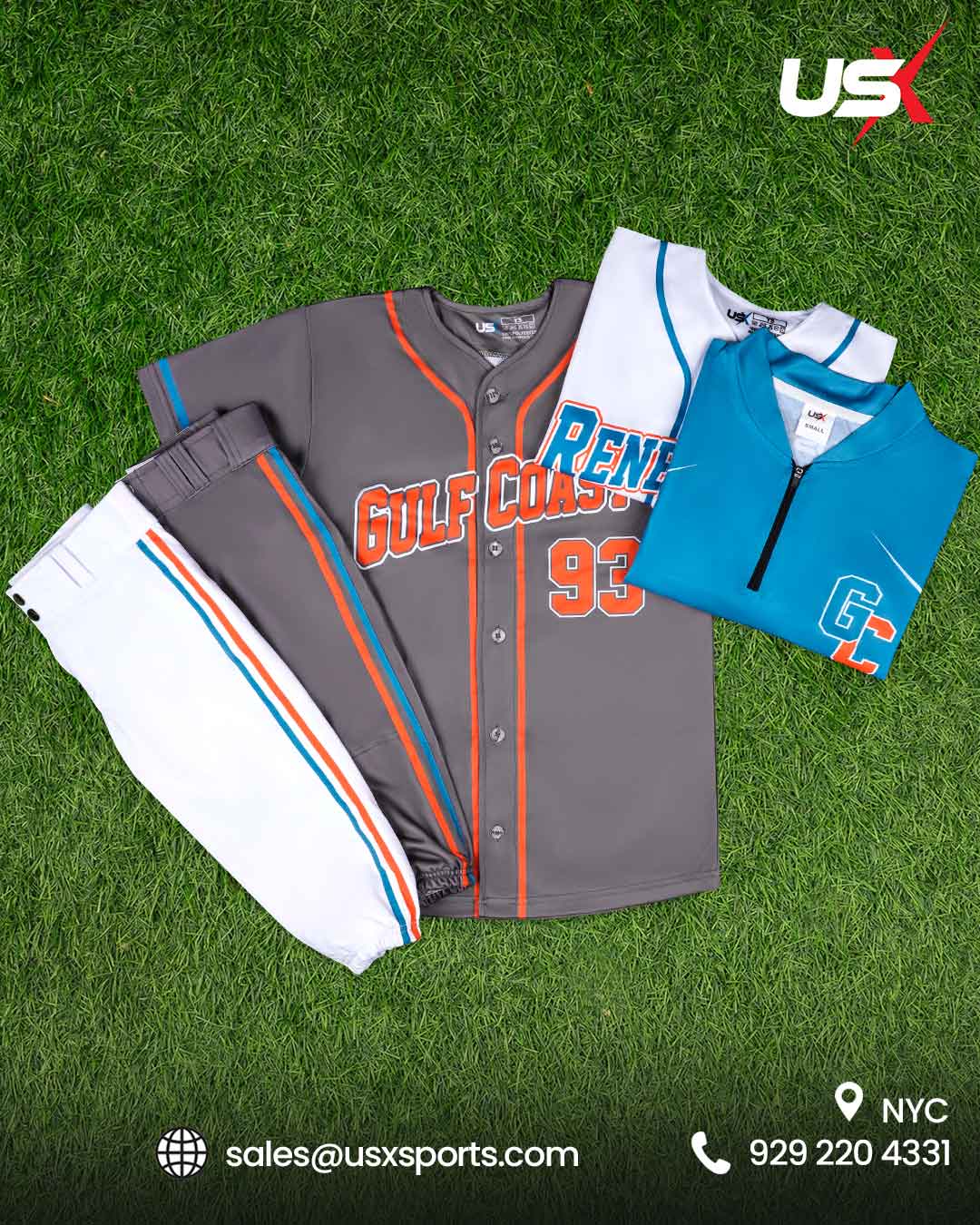
White Softball Pants
White pants create a traditional athletic appearance and can coordinate with many jersey colors.
However, dirt and stains may be more visible.
Gray Softball Pants
Gray is another common baseball and softball uniform color.
It may complement navy, black, red, and other team colors.
Black Softball Pants
Black pants can create a strong contrast with bright or light-colored jerseys.
However, darker garments may absorb more solar radiation in direct sunlight, depending on the material and conditions.
Custom Color Options
Some suppliers offer additional colors or custom graphics.
Confirm availability before finalizing the team design.
Consider Home and Away Uniforms
If your team uses multiple jerseys, choose pants that coordinate with the intended combinations.
For example, a team may prefer one pants color that works with both home and away jerseys.
This can simplify ordering, provided the combination meets league requirements.
7. Should Softball Teams Choose Knicker or Full-Length Pants?
This decision often comes down to team identity and player preference.
| Feature | Knicker pants | Full-length pants |
| Appearance | Traditional, below-knee style | Longer leg coverage |
| Socks | Tall socks are typically visible | Socks are often less visible |
| Sizing focus | Waist, hip, knee opening, length | Waist, hip, thigh, inseam |
| Team design | Classic softball look | Traditional or modern look |
| Fit considerations | Knee opening and hem position | Ankle fit and overall length |
When Knicker Pants May Be Appropriate
Teams seeking a traditional appearance with visible tall socks may prefer knicker pants.
When Full-Length Pants May Be Appropriate
Teams wanting additional leg coverage or a different silhouette may prefer full-length pants.
When Tapered Pants May Be Appropriate
Players who prefer a narrower lower-leg fit may choose tapered styles, provided the fit remains comfortable.
The best decision is one that balances team appearance, athlete comfort, and garment availability.
8. How to Organize Softball Pants Sizes for an Entire Team
Collecting sizes for a team requires a consistent system.
Create a Master Roster
Prepare a spreadsheet containing each player's name, team, jersey size, pants size, preferred style, and any approved length requirements.
Separate Jersey and Pants Sizes
Do not assume a player needs the same size in both garments.
Record Custom Measurements Clearly
If your supplier accepts specific inseam measurements, record them in a dedicated column.
Do not mix inches and centimeters without clear labels.
Confirm Youth and Adult Categories
Identify the sizing system for each player.
Have Parents or Players Review Sizes
Before production, ask each family or player to verify the submitted information.
Submit One Final Roster
Use a clearly labeled final spreadsheet rather than multiple conflicting versions.
This helps reduce ordering errors.
9. Common Softball Pants Sizing Mistakes
Ordering Based Only on Age
Players of the same age may require different sizes.
Measuring the Body and Comparing It Directly With a Flat Garment Chart
Body circumference and flat garment measurements are different.
Follow the supplier's sizing instructions.
Measuring the Inseam Incorrectly
Use the crotch seam as the starting point when measuring a garment inseam, unless instructed otherwise.
Ignoring Hip and Thigh Measurements
Waist size alone may not provide enough information.
Assuming Every Pants Style Fits the Same
Knicker, full-length, and tapered pants can use different patterns.
Forgetting About Player Preferences
Some athletes prefer a relaxed fit, while others prefer a closer athletic cut.
Ordering Without Reviewing Samples
When samples are available, trying them on can help reduce uncertainty.
10. When Should Teams Order Custom Softball Pants?
Custom softball pants require time for sizing confirmation, order approval, production, and shipping.
Begin Planning Early
Start collecting sizes well before the season begins.
Allow Time for Samples
If your organization needs sample garments, include that step in your schedule.
Confirm Customization Requirements
If pants include team graphics, stripes, or other design elements, approve the details before production.
Ask About Production Timing
Confirm the supplier's estimated completion date for the exact order.
Allow Time for Distribution
Try to receive the uniforms early enough to check sizes and distribute garments before the first game.
Plan for Late Additions
Ask about reorder availability and minimum quantities.
Do not assume additional pants can be produced immediately.
11. Softball Pants Ordering Checklist
Before approving your order, confirm:
- The pants style is finalized.
- Youth and adult sizing categories are identified.
- Waist measurements have been checked.
- Hip and thigh fit has been considered.
- Inseam lengths are correct.
- Custom length requirements are clearly recorded.
- Fabric composition and construction are understood.
- Pants colors coordinate with the jerseys.
- Player sizes have been reviewed.
- Final quantities match the roster.
- Production and shipping estimates are confirmed.
- The planned delivery date allows time for distribution.
Frequently Asked Questions About Custom Softball Pants
What is the difference between softball knicker pants and full-length pants?
Knicker pants typically end below the knee and are worn with tall socks. Full-length pants extend toward the ankle.
How do you measure the inseam on softball pants?
Lay the pants flat and measure from the crotch seam down the inside leg to the bottom hem, following the supplier's instructions.
Should softball pants fit tightly?
They should fit securely while allowing comfortable running, crouching, fielding, and other softball movements. Excessive tightness may restrict movement.
Are youth softball pants sized differently from adult pants?
Yes. Youth and adult sizing systems may use different measurements and proportions.
What fabric is commonly used for softball pants?
Polyester and polyester-based blends are common. The appropriate fabric depends on construction, fit, durability requirements, and intended use.
Can teams order custom inseam lengths?
Some custom uniform suppliers may offer length options or adjustments. Confirm the available measurements and customization requirements before ordering.
Should players order the same size jersey and pants?
Not necessarily. Jerseys and pants have different fit requirements, so sizes should be selected separately.
Final Thoughts: The Right Softball Pants Start With Accurate Measurements
Choosing custom softball pants involves more than selecting a color and size label.
Coaches should consider garment style, waist and hip fit, inseam length, fabric construction, and player preferences.
For organizations ordering uniforms for multiple players, consistent measurement methods and accurate rosters can help reduce confusion.
Whether your team prefers traditional knicker pants or full-length styles, careful planning can make the uniform ordering process easier.
Order Custom Softball Uniforms With USX Sports
Looking for custom softball jerseys, pants, or complete team uniforms?
provides custom softball uniforms and team apparel for youth teams, schools, travel organizations, and leagues.
Our team can help you discuss available pants styles, sizing options, fabrics, team colors, and uniform customization.
Whether you're ordering for one softball team or coordinating uniforms across several age divisions, contact USX Sports to review your requirements and request a quote.